Applications
- Materials science: electrical, magnetic and mechanical properties
- Polymers and thin organic films
- Biology / Biotechnology
- Nanomaterials / Nanostructures
- Nanomachining / Nanomanipulation
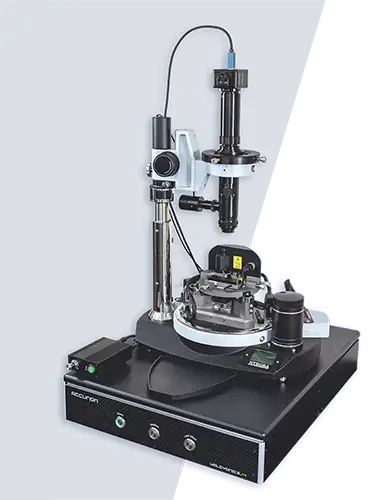
Universal scanning probe microscope, realizing more than 40 methods of atomic force and tunneling microscopy. The functionality of the basic model can be significantly extended; the microscope can be easily integrated with other analytical methods into more powerful measuring systems.
NTEGRA Prima is a multifunctional designed for the most common tasks in the field of Scanning Probe Microscopy. The device can perform more than 40 measurement techniques, allowing for precise and high-resolution analysis of physical and chemical properties. The microscope is versatile in its functionality and measurement capabilities, yet convenient and easy to use. NTEGRA Prima offers the possibility to examine samples at the atomic and molecular level in different environments - in air, liquid and controlled environment. The modular design provides a unique opportunity to configure the instrument for specific applications and research methods.
The NTEGRA Prima offers several scanning options: scanning by sample or scanning by probe, as well as simultaneous probe and sample scanning (so-called DualScan). Scanning by sample is performed using interchangeable scanners integrated into the basic unit and is suitable for small samples and ultra-high resolution.
Scanning by probe is performed by scanning heads. The advantage of this type of scanning is a large range (up to 100x100x10μm) and the ability to examine large samples (up to 100mm in diameter). In addition, such measuring heads can be used as remote measuring devices, which makes it possible to examine objects of unlimited size. The unique DualScan mode allows to extend the scanning range up to 200x200x20 µm, which can be useful for studying living cells or MEMS components.
Built-in three-axis closed-loop control sensors trace the actual displacement of the scanner and compensate for unavoidable imperfections of piezoceramics, such as non-linearity, creep and hysteresis. The sensors have a low noise level, allowing for working with closed-loop controls on very small areas. This is particularly valuable for nanomanipulation/nanolithography operations and for measuring very small objects.
The integrated optical video system is ergonomic, easy to use and provides spatial resolution of 1 µm. It allows real-time visualization of the scanning process. The front panel of the instrument has an LCD monitor that displays temperature and relative humidity information while the instrument operation.
In air&liquid: AFM (Contact + Semi-Contact + Non-Contact)/ Lateral force microscopy/ Phase Imaging/ Force Modulation/ Adhesion Force Imaging/ Lithography: AFM (Force)
In air only: STM/ Magnetic Force Microscopy/ Electrostatic Force Microscopy/ Scanning Capacitance Microscopy/ Kelvin Probe Microscopy/ Spreading Resistance Imaging/ Piezoresponse Force Microscopy/ Lithography: AFM (Current, Voltage)
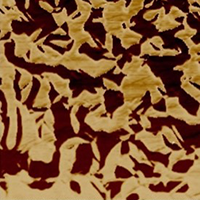 |
PMN-PT single crystal. Image size: 10x10 µm. Vertical Piezoresponse Force Microscopy imaging. Phase signal. |
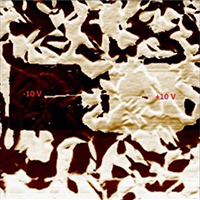 |
PMN-PT single crystal. Image size: 10x10 µm. Vertical Piezoresponse Force Microscopy imaging. Phase signal after polarization by voltage -10 V and +10 V. |
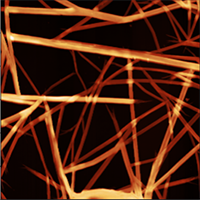 |
Anionic thiacalixarenes on Si surface coated with cationic poly(ethyleneimine). AFM semi-contact mode. Scan size: 30x30 µm. Image courtesy: Dr. Botnar, Novikov, ITMO; Langmuir – 2024 |
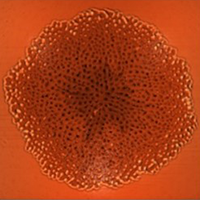 |
SOI substrate after Si:Er deposition. Scan size: 70x70 µm. Image courtesy of Dr. Shaleev, IPM. |
 |
Monolayer steps on the Si surface. Scan size: 5x5 µm. Image courtest: Dr. Jerry Floro, University of Virginia. |
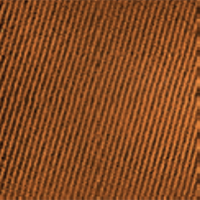 |
Parallel hemicylindrical micellas on HOPG. Scan size: 200x200 nm. Image courtesy: Dr. Schiepp, W&M. |
| Scan type | Scanning by sample | Scanning by probe* | |
| Sample size | Up to 40 mm in diameter | Up to 100 mm in diameter | |
| Up to 15 mm in height | |||
| Sample weight | Up to 100 g | Up to 300 g | |
| XY sample positioning | 5×5 mm | ||
| Positioning resolution | 5 µm | ||
| Scan range | 100x100x10 µm | ||
| Up to 200x200x20 µm (DualScan mode) | |||
| Non linearity, XY (with closed loop sensors) |
≤ 0.1% | ≤ 0.15% | |
| Noise level, Z (RMS in bandwidth 1000 Hz) | With sensors | 0.04 nm (typically), ≤0.06 nm |
0.06 nm (typically), ≤0.07 nm |
| Without sensors | 0.03 nm | 0.05 nm | |
| Optical viewing system | Optical resolution | 1 µm | 3 µm |
| Field of view min | 0.4-0.3 mm | 0.5-0.4 mm | |
| Field of view max | 4.9-3.7 mm | 6.5-4.9 mm | |
| Continuous zoom | Available | ||
| Vibration isolation** | Active | 0.6-200 Hz | |
| Passive | > 200 Hz | ||
* Scanning head can be configured to serve as a stand-alone device to measure specimens of unlimited sizes.
** option.
Prima integrates more than 40 techniques commonly used in Scanning Probe Microscopy (SPM), spectroscopy and lithography. Consequently, Prima is an ideal SPM tool for thoroughly investigating the physical and chemical properties of samples with the highest possible precision and performing high-resolution scans.
An integrated optical viewing system with a resolution of up to 1 µm allows targeting the tip and controlling the measurement process in real time. The NTEGRA Prima system supports all types of scanning required for various samples. It can be used for scanning by sample, by probe or simultaneously by both methods. This also increases the scanning range to up to 200 µm in the XY plane and up to 20 µm along the Z axis.
Prima has built-in closed-loop capacitive sensors for all axes (X, Y, Z). These sensors measure the actual scanner displacement and compensate for parasitic piezoceramics properties including non-linearity, hysteresis and creep with extremely low noise level. This enables closed-loop control on the small fields – just what you need for precise lithography with perfect and accurate linearity.
The NTEGRA Nanolab is designed with an open hardware and software architecture. This allows various compatible assemblies and components to be used in the instrument using a simple plug&play method. Due to the modular organization, the specialization of the basic atomic force microscope can be easily changed or expanded. This design provides the unique ability to configure the instrument for specific applications and specific research techniques.
Thanks to its open architecture, the functionality of the NTEGRA Prima can be significantly expanded. The modular design allows the system to be supplemented with external magnetic field measurements, sample temperature experiments, near-field optical microscopy, Raman spectroscopy, and many other options.